
 Free gifts with orders of €150 or more

 Loading...

Cold-resistant cable ties / Ty-raps 200mm x 4.8mm
per 100 Pieces
 Easy to use Universal application Quality guarantee


From a distribution board in a basement to a solar array on a factory roof: every installation depends on the small consumables that keep the cable where it belongs. Since 2007, we have been the go-to wholesaler for cable ties, fastening materials and installation tapes, supplying electrical contractors, panel builders, data centres, marine installers and maintenance crews. Everything you see below is held in our own warehouse — no dropshipping, no waiting for a supplier to get around to shipping it.
The cable ties you use inside a meter cupboard are not the ones for a flat roof or a tunnel. That is why we organise the range by the load the tie has to withstand: tensile strength, temperature, UV exposure and chemicals.
The standard tie is made from polyamide 6.6: strong, slightly flexible and self-extinguishing to UL94 V-2. In widths from roughly 2.5 to 13 mm and lengths from 100 to over 1000 mm, it covers almost all installation work — from a small bundle of control wiring in a panel to a heavy run of power cable on a cable tray. Use white cable ties indoors, inside enclosures and behind walls. Where the work stays visible or catches daylight, choose black tyraps: the carbon black in the compound gives the tie a far longer outdoor service life than a natural-coloured version.
The moment the cable goes outside, UV becomes the deciding factor. For PV installations, façade wiring, charging points and exterior lighting, work with extra UV-resistant tyraps, which hold their tensile strength for years where an ordinary tie turns brittle and snaps. In freezing conditions — cold stores, outdoor equipment in winter — cold-resistant tyraps prevent breakage during installation. And wherever corrosion, heat or chemicals come into play (marine installations, boiler rooms, process industry, tunnels), reach for stainless steel cable ties in 304 or 316 grade, which also survive a fire by a wide margin.
Cold-resistant cable ties / Ty-raps 200mm x 4.8mm
per 100 Pieces Easy to use Universal application Quality guarantee  Stainless steel cable ties 840mm x 8mm - 100 pcs
per 100 Pieces Bundle diameter: 265.7 mm Tensile strength: 163.1 kg Fast delivery 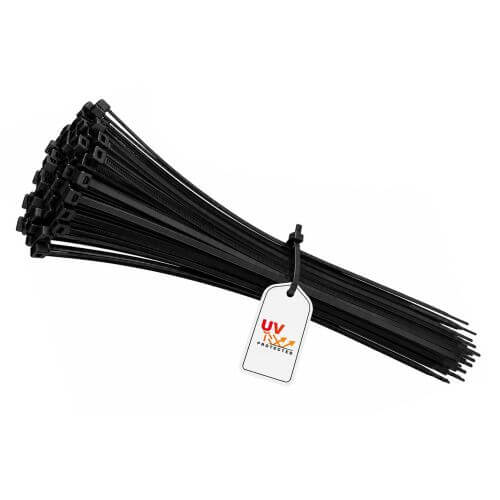 24 years UV-resistant cable ties - 370mm x 7.6mm - Black
per 100 Pieces Easy to use Universal application Durable and reliable  7 years UV-resistant cable ties - 368mm x 4.8mm - Black
per 1.000 Pieces Free shipping from €75 Universal application Durable and reliable
Around transformers, in boiler rooms and alongside exhaust runs, ambient temperatures sit well above what polyamide 6.6 tolerates in the long term; that is where heat-resistant cable ties belong. If the installation is still changing — a test rig, a panel under construction, a temporary supply — resealable cable ties save you cutting and re-tying. In food and pharmaceutical plants, the HACCP plan often calls for detectable tyraps, which the metal detector picks up if a fragment breaks off. Always trim with a cable tie tensioning tool: it cuts flush with the head, so no sharp spur is left behind for an engineer to catch a hand on.
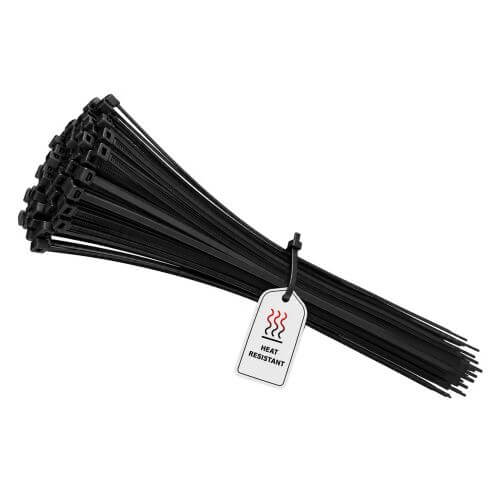 Heat resistant Tyraps 370mm x 4.8mm
per 100 Pieces Heat-resistant: -40 to +120 °C Tensile strength 22.2 kg Bundle diameter up to 102 mm  Yellow resealable cable ties 200 mm long x 7.6 mm
per 100 Pieces Tensile strength: 22.2 kg Tie diameter: 50 mm Quality guarantee  Detectable cable ties 98mm x 2.5mm - 100 pieces
per 100 Pieces Easy to use Ordered before 3:30 PM, shipped today Free gifts when you spend €150  Cable tie pliers for width 2.5mm to 9mm - 1 Piece red
per 1 Pieces Tighten and cut For nylon cable ties Directly available
A tie on its own holds nothing to the wall. The fastening materials determine how the bundle ends up on the ceiling, the trunking or the enclosure door.
In an occupied building you want to drill as few holes as possible. Cable tie mounts are plastic bases with a self-adhesive underside; you thread the cable tie through the slot and fix a bundle to an enclosure door, a cable duct or a smooth wall. They come in several base sizes so you can match the mount to the width of the tie. For single runs and data cables along a skirting board or desk, self-adhesive cable clips are quicker: click the cable in and move on. Always degrease the surface before sticking — dust, silicones and fresh paint are the main reasons mounts let go later.
If the bundle carries weight, or hangs where heat attacks the adhesive, screw it down. Combine screw mounts with wall plugs for a fixing that stays put in concrete and sand-lime brick for years. For conduit, pressure lines and thin pipework, use pipe clamps, which hold the pipe clear of the wall. Where you need several fixing points in a straight line in a hurry — a plant room, a workshop, a temporary site supply — perforated mounting strip is the fastest answer: cut to length, bend and screw down.
 3M® Black Cable Tie Mounts, 28mm x 28mm
per 100 Pieces For tyraps up to 4.8mm wide With screw hole Fast delivery time  Cable ties screw mounts, for cable ties up to 4.8mm, black
per 100 Pieces Mounting hole Ø3,8mm UV-resistant 15,5mm x 10,5mm x 6,9mm  Pipe clamp - for pipes of Ø16mm - 100 pieces grey
per 100 Pieces Stackable Without bracket Top quality  Wall plugs for cable ties - 38mm - 100 pieces black
per 100 Pieces Cables firm on the wall UV-resistant, outdoor 8 mm hole, 100 pieces
Heat shrink tubing on a roll lets you cut exactly the length you need, which produces far less offcut than pre-cut pieces when you are working on soldered joints, ferrules and repaired sheathing. The polyolefin tubing shrinks at a 2:1 ratio and closes tightly around the joint under a hot air gun: insulation, mechanical protection and strain relief in one operation. Heat evenly from the middle outwards so no air gets trapped.
In a patch cabinet, a control panel or a broadcast rack, the cabling changes constantly. Hook-and-loop tape on a roll is cut to length and opened hundreds of times without damaging the jacket — exactly what fibre and Cat cable need, since they cope poorly with the point load of a tightly pulled plastic tie. Spiral wrap does a similar job where you want a tidy, flexible bundle that still accepts an extra core later on.
Insulation tape made from soft PVC stretches with the conductor diameter and stays supple for years. Beyond insulating, the coloured versions are used for phase identification: brown, black and grey for L1, L2 and L3, blue for neutral and green-yellow for earth. Wrap with roughly half overlap and lay the final turn on without tension, otherwise the end creeps back over time.
On ductwork, insulation jackets and vapour barriers, aluminium tape seals seams airtight and reflects radiant heat. When you run a cable protector or hose across a walkway temporarily, floor marking tape flags the route and anti-slip tape keeps a stair or platform safe to use. On stair nosings, cabinets and tool cases in poorly lit plant rooms, reflective tape makes obstacles visible. For quickly closing a penetration, bundling a temporary run or taping up a crate, duct tape is still the van's workhorse, and double-sided tape fixes trunking, a cable channel or a sign without visible fasteners.
 Aluminum tape 50mm x 50m - 1 roll
per 1 Pieces Fast sealing Packed per roll Various applications  Floor marking tape Yellow/Black 50mm x 33m. 1 roll.
per 1 Pieces Clear deposition Packed per roll Durable PVC  Duct tape 50 mm x 50 meters. Gray. 24 rolls.
per 24 Pieces Value box of 24 rolls Strong cloth backing Tears cleanly by hand 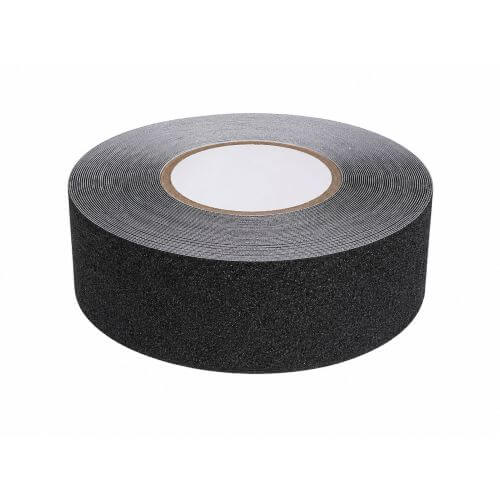 Anti-slip tape 50mm x 18.3mtr - 1 Roll black
per 1 Pieces For inside and outside Safe environment Various applications  Double-sided linen tape 50mm x 50m - 1 Roll yellow
per 1 Pieces Tear by hand 50m per roll Hot melt adhesive  Reflective tape 45mm x 10m - 1 Roll black/yellow
per 1 Pieces High visibility Weather-resistant Versatile application
If you are working in a building that stays in use, cordoning off your work area is part of the job. Barrier tape secures an open distribution board, a floor chase or a stripped ceiling so nobody walks into it. Cable ties with a marker label give every core or bundle a number you write on site — during a fault or an upgrade that saves hours of tracing. For permanent identification, labels and cash register rolls include PVC and metal labels. For the engineer, there are work gloves, and if you want your company name on the tie itself, look at printed cable ties.
| Product group | Versions | Dimensions | Material | Use in electrical and installation work |
|---|---|---|---|---|
| Cable ties | White, black, coloured, UV-resistant, cold-resistant, heat-resistant, heavy duty, resealable, detectable, stainless steel | Width 2.5 – 13 mm; length 100 – 1000+ mm | Polyamide 6.6 (UL94 V-2), polyamide 12, stainless steel 304/316 | Bundling power, control and data cable; mounting to trays, trunking and basket tray |
| Cable tie mounts and clips | Self-adhesive, slotted for cable ties; clips for single cables | Base sizes matched to tie widths of 2.5 – 9 mm | Polyamide with acrylic adhesive | Fixing to enclosure doors, cable ducts and smooth walls without drilling |
| Screw mounts, wall plugs, pipe clamps | Screw-fixed, with and without plug; clamps for conduit | Various pipe diameters and screw sizes | Polyamide, polypropylene | Permanent fixing points in concrete, sand-lime brick and plasterboard |
| Heat shrink tubing on a roll | 2:1 shrink ratio, cut to length | Various diameters, supplied on a roll | Polyolefin | Insulating joints, repairing sheathing, strain relief |
| Hook-and-loop tape | Supplied on a roll | Various widths and roll lengths | Nylon/polyester | Reusable bundling of fibre, Cat and patch cabling |
| Insulation tape | Black and in phase colours | Rolls of 10 and 20 metres, approx. 0.15 mm thick | Soft PVC with rubber adhesive | Insulating joints, phase marking and core identification |
| Marking and signalling tape | Floor marking, anti-slip, reflective, aluminium | Various widths and roll lengths | PVC, aluminium foil, grit anti-slip laminate | Marking cable routes, keeping walkways safe, sealing ducts airtight |
| Barrier tape | Printed and unprinted | Rolls in various lengths | Polyethylene | Cordoning off open boards, chases and work areas |
An engineer standing on site without ties or insulation tape costs more than the entire order is worth. That is why our consumables are held in our own warehouse. Ordered on working days before 3:30 PM? Then your order will be shipped the same day.
Consumables add up: an electrical contractor gets through tens of thousands of them a year. Buying in bulk packs shows up directly in your cost per metre of cable tray. And when materials have to travel to a project or a customer, shipping materials and protective and filling materials cover everything needed to get a panel, a test instrument or a light fitting to site undamaged.
Torn between a UV-resistant polyamide tie and stainless steel, or between an adhesive mount and a screw mount? Our staff will think it through with you based on the environment, the load and the service life you expect from the fixing. Do you have questions about which size of cable ties is best suited to your situation? Please don't hesitate to contact us — by phone on +31 184 – 614256, via info@kortpack.nl or via WhatsApp.
Outdoors, UV exposure is the governing load. A natural-coloured polyamide tie turns brittle in full sun within a few seasons. Choose a black or an extra UV-resistant version; the carbon black in the compound blocks the UV. For coastal sites, roofs that build up a lot of heat and installations expected to last decades, a stainless steel tie is the safest choice.
Standard polyamide 6.6 is self-extinguishing to UL94 V-2: the tie will not keep burning on its own once the flame is removed. That is not the same as fire resistant. Where a cable route must stay functional during a fire, or where a fire-stopped penetration is being built, specifications generally call for metal supports and stainless steel ties.
Not tightly. A plastic tie applies a point load to the jacket, and with fibre and Cat cable that can affect the geometry and therefore the attenuation. Use hook-and-loop tape on a roll instead: it spreads the force across its full width and can be reused when the patching changes.
Almost always it comes down to the surface. Degrease and dust the spot, do not stick to fresh paint or a silicone-based coating, and press the mount firmly for a few seconds so the acrylic adhesive can key in. It only reaches full strength after about a day, so do not load the bundle fully straight away. If it gets warm, or the bundle carries weight, use a screw mount.
In a common three-phase installation you mark L1, L2 and L3 in brown, black and grey, neutral in blue and earth in green-yellow. Always check the identification agreed in the project or specification; older installations still use other colour schemes.
In substance, nothing: it is the same polyolefin tubing with a 2:1 shrink ratio. From a roll you cut only what you need, which means considerably less waste when conductor sizes vary and on repair work. For a service van with limited storage, one roll per diameter is more practical than an assortment box.
We strongly recommend it. Side cutters leave an angled spur that cuts through a work glove and chafes against cable jackets. A cable tie tool cuts flush with the head and adds an adjustable, repeatable tension — so you do not end up with one bundle too loose and the next pulled tight enough to deform the jacket.
Yes. You can order from a single bag or a single roll, with no minimum order value. As your usage grows, you simply move up to bulk packs.





 Den Webshop auf Deutsch ansehen
 View the webshop in English
 Ver la tienda online en Español
 Voir la boutique en ligne en Français
 Visualizza il negozio online in Italiano
 Bekijk de webshop in het Nederlands