

 Free gifts with orders of €150 or more



 Loading...
What are you really choosing on?
Most people pick on width and price. Those are precisely the two properties that say least about whether your floor survives. Across our range of floor protectors, five factors together decide whether a product fits your situation.
1. What is underneath?
A hard, fully cured surface – concrete, tiles, a poured floor – will take almost any floor protection. A soft or delicate surface sets conditions. On carpet you need a film that follows the pile and will not slide; on freshly lacquered parquet the protection must not leave adhesive residue; on a screed that has not fully cured, the material must not trap the moisture.
2. How heavy is the traffic?
Two painters with brushes is not the same as a mobile scaffold tower, a pallet truck or a plastering crew with wheelbarrows. With rolling equipment, point load is the problem: a thin fleece tears under a steel wheel, whereas a 280 gsm cardboard runner spreads the pressure.
3. How long will it stay down?
A weekend job asks for something different than a three-month refurbishment. Self-adhesive protective film is designed for temporary use – leave it down too long and the adhesive keys in, leaving residue when it comes up.
4. How much moisture will it see?
Plastering, levelling compound and spray work put litres of water onto the floor protection. The question is then not only whether the material is liquid-tight, but whether it holds the moisture. An absorbent non-woven draws the water in and keeps the walkway dry and safe; a smooth film leaves it sitting on top, giving you a mirror-slick and genuinely dangerous work surface.
5. Is this one job or several?
If you are on a different site every week, a robust runner you can roll up and take with you pays off: a felt or non-woven length survives several projects without tearing. For a one-off renovation at home, a cardboard roll or a length of protective film is the sensible choice – afterwards it simply goes into the paper or plastics waste.
The material types at a glance
The phrase "floor protection" covers five different materials with five different strengths. They are not interchangeable.
Cardboard runner: the load spreader
The Cover-it® Classic cardboard runner is fibre-reinforced board with a waterproof PE coating on both sides. At 280 gsm it is the sturdiest material in the category: it spreads point loads, lies flat and shrugs off dropped tools. The double coating means moisture from above cannot get through and rising damp from below cannot soften the board.
The cardboard comes in narrower and wider versions, so you can cover either a walkway or a whole room. One thing to know: precisely because it is coated on both sides, this material is not breathable. On a floor that still has to cure, that is a problem – more on that below.
Felt with PE coating: the cushioning layer
The Cover-it® Classic Soft at 100 cm x 10 metres and the longer Classic Soft XL at 100 cm x 25 metres are built from 240 gsm polyester felt with a PE coating on the underside. That coating does two jobs at once: it makes the runner liquid-tight and acts as an anti-slip layer, so the length does not shoot out from under your feet.
The felt itself dampens sound and absorbs impact. That makes this type the obvious pick in occupied buildings, apartment blocks and shops where people carry on living or trading while the work goes on. For smaller jobs, or as a mat under a cutting station, the Classic Soft cloth of 1 x 1 metre is a useful addition.
Non-woven composite: the absorber
Cover-it® Super weighs only 110 gsm itself, but takes up around 260 gsm of moisture – comfortably more than twice its own weight. The heavier Cover-it® Stuc & Paint XL at 180 gsm goes to roughly 300 gsm.
The mechanism is a sandwich: an absorbent non-woven top layer that wicks moisture away from the walking surface, and a liquid-tight layer beneath that stops it reaching the floor. Knock over a bucket of water and the top side is walkable again within minutes while the floor stays dry. These materials are also oil- and grease-resistant and tear-resistant, so you can roll them up afterwards and lay them out again on the next job.
Self-adhesive protective film: the temporary second skin
Where a loose runner always risks shifting and curling edges, protective film sticks itself to the surface. The self-adhesive covering film for carpet and floor coverings is a 70 cm wide LDPE film with a solvent-free acrylic adhesive system, tuned specifically to soft surfaces such as carpet and rugs. For hard and lacquered floors – parquet, laminate, vinyl, PVC and natural stone – there is a version with adjusted adhesive strength.
Mind the service life: these films are designed to stay down for a maximum of roughly two months. After that the risk of adhesive residue rises sharply. For windows, frames and door casings, do not use floor film but the narrower Cover-it Glass & Frame of 25 cm x 100 metres.
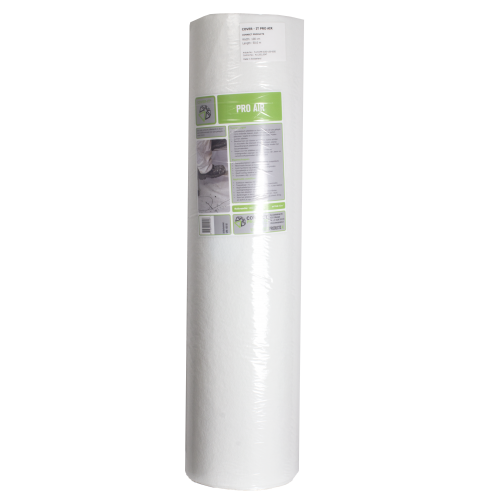
per 1 Pieces  Breathable membrane For fresh floors 50 m² per roll

per 1 Pieces For hard/lacquered floors Self-adhesive, no residue 42 m² per roll 
per 1 Pieces For small jobs Anti-slip layer Good protection 
per 1 Pieces For soft and hard floors 240 g/m² felt 10 m² per roll 
per 1 Pieces 25 cm wide Glass protection UV-resistant
per 1 Pieces 50 m² per roll Glass protection Long-lasting use 
per 1 Pieces Self-adhesive on carpet Anti-slip and liquid-tight 42 m² per roll 
Liquid-tight and anti-slip Soft and hard floors 50 m² per roll 
per 1 Pieces 280 g/m² runner Moisture- and wear-proof FSC, 100% recyclable 
per 1 Pieces Floor protection Different surfaces 50 m² per roll
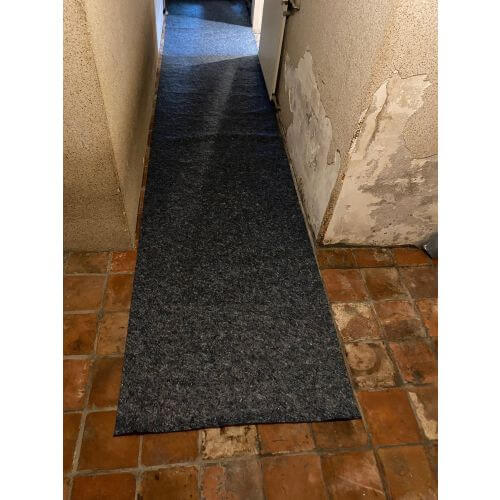


LDPE construction sheeting: the cheap wide cover
Transparent construction sheeting on the roll comes in widths of 200 cm, 400 cm and 600 cm, each 50 metres long. With the wide versions you cover an entire room in a single run, with no seams for moisture to travel through.
Sheeting is waterproof and cheap per square metre, but it is not a walkway. The material offers almost no resistance to sharp tools, turns treacherous the moment water sits on it, and tears under point load. Use it where nobody walks: over stored materials, over a covered staircase, or as a moisture barrier beneath a proper floor protection runner.

per 1 Pieces 50 m² in one piece Large job size Cut to size
per 1 Pieces 20 m² in one piece Transparent, clear view Cut to size 
per 1 Pieces 200 cm wide, 50 m/roll 100% recycled PE Natural, keeps visibility
per 1 Pieces 400 cm wide, 50 m/roll 100% recycled PE Natural, keeps visibility
per 1 Pieces 600 cm wide, 50 m/roll 100% recycled PE Natural, keeps visibility 
per 1 Pieces 100% recycled PE Opaque black 600 cm wide


The specifications side by side
The table below sets the key properties of the five material types against each other. Find the property that is decisive in your situation first, then read left to see which material goes with it.
| Product | Material | Width | Length / area per roll | Weight | Moisture uptake | Reusable | Strong at |
|---|---|---|---|---|---|---|---|
| Cover-it® Classic (cardboard) | Fibre-reinforced board, PE-coated both sides | 60 and 130 cm | approx. 35 – 50 m² | 280 gsm | None – fully sealing | Limited | Heavy loads, rolling equipment |
| Cover-it® Classic Soft | Polyester felt with PE coating | 100 cm | 10 m (10 m²) | 240 gsm | Limited, felt catches splashes | Yes | Sound damping, anti-slip |
| Cover-it® Classic Soft XL | Polyester felt with PE coating | 100 cm | 25 m (25 m²) | 240 gsm | Limited, felt catches splashes | Yes | Long walkways in occupied buildings |
| Cover-it® Super | Polyester composite non-woven | 90 cm | approx. 50 m² | 110 gsm | Up to approx. 260 gsm | Yes | Wet plastering, oil and grease |
| Cover-it® Stuc & Paint XL | Polyester non-woven, tear-resistant | 100 cm | approx. 50 m² | 180 gsm | Up to approx. 300 gsm | Yes | Intensive spraying and painting |
| Self-adhesive film for carpet | LDPE with acrylic adhesive | 70 cm | 60 m (42 m²) | Thin film layer | None – fully sealing | No | Carpet, stairs, will not shift |
| Self-adhesive film for hard floors | LDPE 80 my with acrylic adhesive | 70 cm | approx. 42 m² | 80 my | None – fully sealing | No | Parquet, laminate, vinyl, PVC, stone |
| Transparent construction sheeting T200 | LDPE film | 200, 400 and 600 cm | 50 m | Type 200 | None – fully sealing | Limited | Covering large areas seamlessly |
What does gsm actually tell you about quality?
Gsm is the weight of the material per square metre and says something about density first of all, not automatically about strength. With cardboard and felt, weight does track robustness: 280 gsm board carries considerably more than a thin sheet. With non-wovens it works differently. Cover-it® Super weighs less than a felt runner at 110 gsm, yet performs better on wet work because the fibre structure binds far more moisture than its own weight. So compare weights within the same material type, not across types.
Why should cardboard not go on a fresh screed?
A cement-based or anhydrite screed gives off moisture for weeks while it cures. Lay a board runner coated on both sides over it and that moisture has nowhere to go. It sits beneath the protection and causes staining, lime bloom and, at worst, a screed that never reaches full strength. On a floor that still has to dry, choose an open, vapour-permeable material – or wait to cover it until the floor is measurably dry. The same logic applies to newly poured floors and fresh levelling compound.
Which floor protection for which job?
Plastering, spraying and levelling
Here moisture uptake is the decisive property. Choose an absorbent non-woven such as Cover-it® Super or Stuc & Paint XL: it pulls splashes and spills straight away from the walking surface, so no puddles form for someone to slip in. Combine the runner with tarpaulins over the furniture and masking tape along the skirting boards.
Painting and interior refurbishment in occupied buildings
If people carry on living or working there during the job, comfort counts. A felt runner with PE coating walks pleasantly, dampens sound and stays put thanks to the anti-slip underside, without you having to tape it down. For a hallway or stairwell, the 25-metre XL version is usually enough in a single run.
Floor laying, stairs and walkways
When carrying packs of laminate, tiles or tools along a route, load spreading matters most. A 280 gsm cardboard runner is right here, provided the floor underneath has cured. On a staircase, cardboard works poorly: it will not stay on the nosings. Choose self-adhesive film there, which follows the shape of the tread.
Carpet and other soft floors
On carpet, loose floor protection has no grip: every length shifts within the hour. The self-adhesive version for soft surfaces is the only reliable solution here. The acrylic adhesive system is solvent-free and, removed in good time, leaves no residue in the pile.
Removals and events
During a removal it is less about moisture and more about scratches and knocks in a short window. A felt runner along the route, backed up with moving blankets around the furniture, furniture covers against dust and plastic corner protectors on vulnerable edges, covers virtually every damage risk. You will find the rest under moving boxes and moving accessories.
Which width should you choose?
For a walkway, 60 to 100 cm is enough: wide enough to pass with a wheelbarrow or a pack of skirting boards without stepping off the run. To cover a whole room, work with 100 cm lengths taped together, or go straight to sheeting of 400 or 600 cm wide. Rule of thumb: better one run too wide than two extra seams – every seam is a leak point.
The mistakes we see most often
Not taping the seams and edges
Laying two lengths side by side without joining them is the most common mistake. Plaster water always finds the seam. Tape the overlap along its full length and finish the edge along the skirting board too, so nothing can creep underneath the protection. Use a tape that lifts without residue, such as the orange removable PVC tape of 50 mm x 33 metres: strong enough to hold the seam closed, and thanks to the removable adhesive layer it leaves no marks on skirting or floor at handover. The signal colour also marks the route clearly.
Protecting only the floor
Overspray and dust settle on everything horizontal. Cover only the floor and you will be cleaning window sills, radiators and worktops afterwards. Think of protective film for the vertical and delicate surfaces.
Leaving self-adhesive film down too long
The adhesive on protective film is designed for temporary use. If a project overruns and the film stays down for months – especially in sunlight behind glass – the adhesive keys in ever more firmly. Put the removal in the programme rather than leaving it until handover.
Do you need tape to hold the floor protection down?
With a felt runner that has an anti-slip coating, usually not: it stays put by itself. With cardboard, non-woven and sheeting, yes – certainly at the edges and seams. Use masking tape or removable PVC tape rather than ordinary packaging tape; only those are designed to come off without residue or damage to the surface.
Can you reuse a floor protection runner?
That depends on the material and on how you pack it away. Non-woven runners such as Cover-it® Super and Stuc & Paint XL are tear-resistant enough to roll up and lay out again on the next job; felt runners with PE coating likewise, provided they have not been cut through. Cardboard and sheeting can at best be repositioned within the same project. The practical limit is the type of soiling: dried plaster and paint residue make a runner stiff and slippery, and at that point replacing beats reusing.
Is construction sheeting suitable as a walkway?
No. Sheeting is a covering material, not a walking material. As soon as water sits on it, it becomes treacherous, and under a scaffold wheel or a stray screw it tears immediately. Use it where nobody walks, or as a moisture-resistant underlay beneath a proper floor protection runner.
Making the right choice quickly
- Lots of moisture, plastering or spraying: absorbent non-woven (Cover-it® Super or Stuc & Paint XL).
- Heavy loads on a cured floor: 280 gsm cardboard runner.
- Occupied building, sound and comfort: felt runner with PE coating, in 10 or 25 metres.
- Carpet, stairs or lacquered floors: self-adhesive protective film in the right adhesive strength.
- Covering a large area, no foot traffic: transparent construction sheeting up to 600 cm wide.
- Screed that has not yet cured: no double-coated cardboard – choose an open, vapour-permeable material.
Ordering from Kortpack
All the products mentioned are available from stock. Ordered on working days before 3:30 PM? Then your order will be shipped the same day. Enjoy free delivery on orders over €75 excl. VAT, and most rolls carry volume discounts on larger quantities.
Do you have questions about which size of floor protectors is best suited to your situation? Please don't hesitate to contact us — by phone on +31 184 – 614256, via info@kortpack.nl or via WhatsApp.
 Den Webshop auf Deutsch ansehen
 View the webshop in English
 Ver la tienda online en Español
 Voir la boutique en ligne en Français
 Visualizza il negozio online in Italiano
 Bekijk de webshop in het Nederlands