

 Free gifts with orders of €150 or more



 Loading...
What should you actually base your choice on?
Every cable tie is a compromise between four properties. Work through those four and you will usually have your answer within a minute.
1. Tensile strength: what does a cable tie really hold?
Loop tensile strength indicates the force the closed loop can take before it fails. For cable ties this ranges from around 8.1 kg for the lightest versions to 114 kg for heavy plastic ties and 230 kg for the strongest stainless steel cable ties. Do not cut it fine: the stated figure applies at room temperature under a static load. Heat, vibration or fluctuating loads reduce the practical strength, so choose a class up rather than working right at the limit.
2. Length: from bundle diameter to tie length
The stated length is the total length of the strap, not the bundle diameter it will close. As a rule of thumb: bundle diameter × 3.14, plus 25 to 50 mm for the head and a tail to pull on. A 40 mm bundle therefore calls for a tie of roughly 160 to 175 mm. When in doubt, take the next length up – you can trim the excess flush with a pair of cable tie pliers.
3. Width: strength and pressure distribution
Wider straps are not only stronger, they also spread the clamping pressure over a larger area. That is exactly what you want on sensitive cabling: a narrow strap cuts into the sheath under high tension, a wide one does not. For data and fibre optic cables, deliberately choose a wider tie or hook and loop fastener, even when the tensile strength is not needed.
4. Material and environment
Most cable ties are made of polyamide 6.6 (PA 6.6, nylon): strong, resilient and rated between roughly −40 °C and +80 °C. Outside that range, or in aggressive environments, move up to a specialist version: PA 12 or steel-reinforced PA for prolonged UV exposure, and stainless steel 304 or 316 for chemicals, salt water and radiation.
Specifications at a glance
The table below links the common tensile strength classes to strap width, material and application. Use it as a quick shortlist; the exact width and length combinations are shown on each category page.
| Tensile strength | Strap width | Material | Typical application |
|---|---|---|---|
| 8.1 kg | 2.5 – 3.6 mm | PA 6.6 | Thin bundles, IT and data cabling, control panel assembly |
| 18.2 kg | 2.5 – 3.6 mm | PA 6.6 | Light electrical work, bundling leads and hoses |
| 22.2 kg | 4.5 – 4.8 mm | PA 6.6 | General use: installation, maintenance, logistics, events |
| 46 kg | 4.8 – 7.6 mm | PA 6.6 / stainless 304 | Heavier bundles, pipework, fixing to cable tray |
| 54.4 kg | 7.0 – 7.6 mm | PA 6.6 | Construction sites, machine building, temporary structures |
| 79.4 kg | 9.0 – 13 mm | PA 6.6 | Large cable bundles, fencing, tarpaulins and netting |
| 114 kg | 9.0 – 13 mm | PA 6.6 / stainless 304 | Heavy industry, outdoor installations, thick pipe bundles |
| 230 kg | 8 mm | Stainless 304 / 316 | Marine, offshore, chemical plant, high temperatures |
Temperature range for PA 6.6: approximately −40 °C to +80 °C. For applications beyond that, there are cold-resistant cable ties and heat-resistant cable ties.
Which cable tie for which application?
Indoors: control panels, cable trays and server racks
Indoors, UV is irrelevant and what counts is neatness and traceability. White cable ties are the standard here: they disappear against a light background and come in every common size. In data centres and on installations that change regularly, resealable cable ties are more practical – you open them without cutting, so you can add a cable without re-bundling the whole run.
Worth knowing: white and natural cable ties are not UV resistant. Use them indoors only, or in permanently shielded positions.


per 1.000 Pieces
 Short: 100 mm Narrow 2.5 mm 1000 pieces (10×100)

per 1.000 Pieces
Popular all-round tie Versatile in use Strong 3.6 mm band per 1.000 Pieces
Long and sturdy For thick bundles Around pipes and ducts per 1.000 Pieces
Strong nylon: 22 kg 300 mm length Value: 1000 pieces 
per 1.000 Pieces
For large diameters Strong PA66: 22 kg Extra-long 4.8 mm band per 1.000 Pieces
Strong at 54 kg For thicker bundles Tension spread wide per 1.000 Pieces
Powerful: 54 kg For large bundles Site-ready grip Outdoors and in full sun
Outdoors, the colour of a cable tie is not a matter of taste. Black cable ties owe their UV resistance to the carbon black pigment in the polyamide, which absorbs UV radiation before it attacks the polymer chains. For shorter outdoor jobs – a season, a build phase – a standard black tie is enough.
If the installation has to last ten or twenty years, such as the cabling beneath a solar array, choose extra UV-resistant cable ties. These are available with a UV service life of around 7 years and, in PA 12 or steel-reinforced PA 6.6, up to around 24 years. The difference in unit price is small; the difference in replacement cost is not.


per 1.000 Pieces
Order without an account Both business and private Durable and reliable 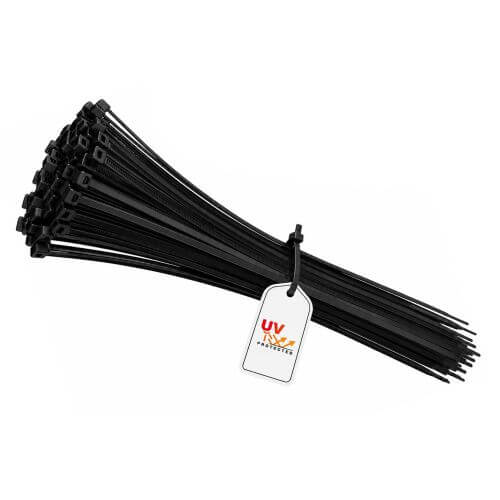
per 1.000 Pieces
Free shipping from €75 Universal application Free gifts when you spend €150 
per 1.000 Pieces
Free shipping from €75 Universal application Free gifts when you spend €150 
per 1.000 Pieces
Order without an account Both business and private Quality guarantee 

per 1.000 Pieces
Easy to use Ordered before 3:30 PM, shipped today Durable and reliable 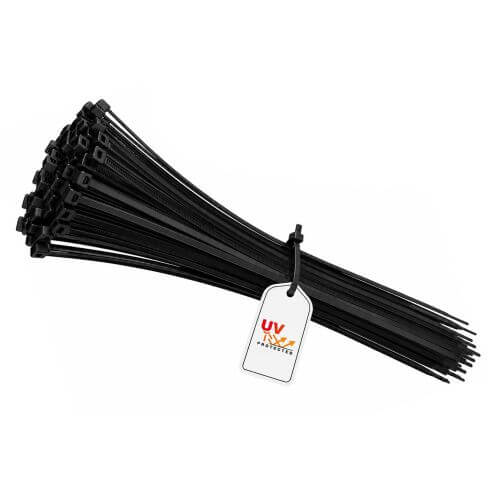
per 100 Pieces
Easy to use Ordered before 3:30 PM, shipped today Free gifts when you spend €150 

per 1.000 Pieces
Free shipping from €75 Universal application Durable and reliable Why does a white cable tie fail outdoors when a black one does not?
UV radiation breaks down the molecular chains in polyamide. The material first loses its resilience and then turns brittle: the tie snaps at the head or along the teeth, often with no visible warning. Carbon black pigment absorbs that radiation and delays the process by years. A white tie has no such protection and can fail within one or two seasons in full sun. Coloured ties sit somewhere in between and are intended for indoor identification, not permanent outdoor fixing.
Heavy bundles, construction and industry
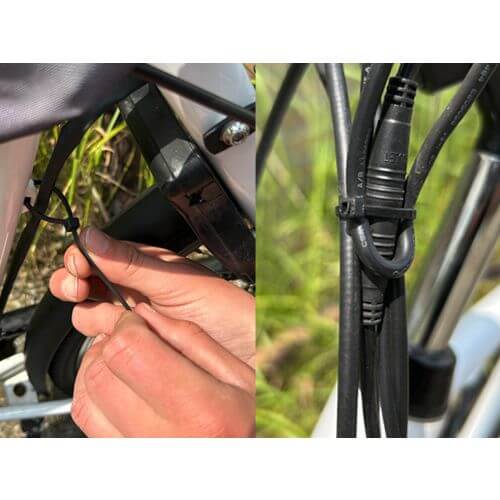
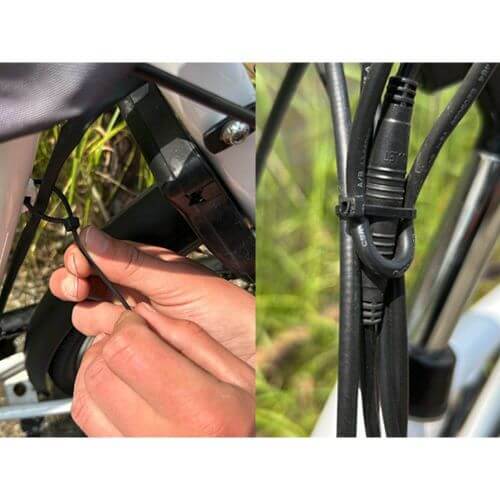
For anything that pulls, vibrates or carries weight, use heavy duty cable ties in the 46 to 114 kg classes. Expect not to be able to tension these properly by hand: from around 7 mm strap width, cable tie pliers are not a luxury but a requirement. They tension to a constant, adjustable force and cut the tail off flush, leaving no sharp point for installers to catch themselves on.
Marine, offshore and chemical environments
Where plastic reaches its limit, stainless steel cable ties keep going. They withstand aggressive chemicals, corrosion, radiation and wide temperature swings. The distinction that matters is the grade: 304 is fine for most industrial applications indoors and out, while 316 contains molybdenum and is considerably more resistant to chlorides – that is, to seawater, salt spray and many process fluids. On a coastal site or in a chemical plant, take 316 if in doubt. Epoxy-coated versions additionally prevent galvanic corrosion against other metals.


per 100 Pieces
Bundle diameter: 61.9 mm Tensile strength: 90.7 kg Popular choice per 100 Pieces
Bundle diameter: 93 mm Tensile strength: 90.7 kg Versatile applications per 100 Pieces
Bundle diameter: 116 mm Tensile strength: 90.7 kg Smooth surface per 100 Pieces
Bundle diameter: 60.9 mm Tensile strength: 163.1 kg Easy to use per 100 Pieces
Bundle diameter: 93.7 mm Tensile strength: 163.1 kg Popular choice per 100 Pieces
Easy to use Ordered before 3:30 PM, shipped today Durable and reliable 

per 100 Pieces
Easy to use Universal application Durable and reliable per 100 Pieces
Order without an account Universal application Free gifts when you spend €150 per 100 Pieces
Resistant to corrosion 53mm bundle diameter 163,1kg tensile strength Food, pharmaceutical and packaging industries
In production environments running HACCP or IFS, a stray fragment of plastic is a genuine hazard. Detectable cable ties are built for exactly this: the blue polyamide contains iron oxide, so fragments are picked up both by a metal detector and on X-ray inspection. They are halogen-free and rated from roughly −40 °C to +85 °C. The signal blue barely occurs in foodstuffs, so it stands out visually as well.


per 100 Pieces
Order without an account Ordered before 3:30 PM, shipped today Durable and reliable per 100 Pieces
Free shipping from €75 Ordered before 3:30 PM, shipped today Durable and reliable per 100 Pieces
Easy to use Ordered before 3:30 PM, shipped today Quality guarantee per 100 Pieces
Order without an account Both business and private Quality guarantee 

per 100 Pieces
Free shipping from €75 Universal application Free gifts when you spend €150 Colour coding, labelling and temporary cordoning
On large installations, colour coding saves hours of searching later. Coloured cable ties are available in blue, red, yellow, green, orange, grey and neon shades among others, so you can run a colour per circuit, department or phase. If you need text as well, choose cable ties with a marker label – with a writing surface for the cable number or destination – or printed cable ties for recurring text. For cordoning off the area around the work, use barrier tape.
Vibration: how do you stop a tie from slowly working loose?
On motors, pumps, conveyors and in vehicle building, an ordinary plastic pawl creeps back a fraction at a time under continuous vibration. Metal tooth cable ties solve this with a stainless steel tooth that bites into the strap rather than resting on it. The same principle sits inside the original Thomas & Betts cable ties, made since 1958 with a non-magnetic stainless steel locking pin – still the reference in aerospace, shipbuilding and heavy industry.
The mistakes we see most often
Over-tightening
By far the most common. A tie that cuts into the cable sheath damages the insulation and, on power cables, restricts heat dissipation. Rule of thumb: after tightening you should still just be able to slide the bundle within the loop. If you are using pliers, set them to the lowest setting that holds the bundle together.
Cutting the tail off with side cutters or a knife
A tail cut at an angle is sharp enough to go through a work glove. Always cut flush with the head – which is precisely why cable tie pliers have a flush cutting jaw.
Can a cable tie be reused?
A standard tie cannot: the pawl engages the teeth irreversibly and releasing it damages the strap. If you expect the bundle to change, go straight for a resealable cable tie or hook and loop fastener. On data cabling, hook and loop is often the better choice anyway: it does not pinch, it is endlessly reusable and it needs no tools.
Bundling but not fixing
A cable tie bundles; it does not fix. To secure the bundle to a wall, ceiling or panel, use the mounting bases in our fastening materials range – self-adhesive versions need no drilling at all. For mounting into masonry or concrete there are cable ties with an expansion anchor, and for a screw fixing straight through the tie there are cable ties with an attachment eye. To finish and insulate the cables themselves, use heat shrink tubing or tape.
Is there a more sustainable alternative?
Yes, and the range is growing. Recycled cable ties are made from reclaimed polyamide and perform on a par with the standard version. FibreStrap cable ties go a step further: they are made from Scandinavian wood fibres sourced from certified, sustainable forestry. These paper-based ties reach a tensile strength comparable to conventional plastic ties and can simply go out with the paper recycling. And wherever the connection has to be opened regularly, hook and loop fastener is by definition more sustainable: you reuse the same strap for years.
In short: your choice in four questions
- Indoors or outdoors? White or coloured indoors, black outdoors, extra UV resistant in prolonged sun.
- How heavy is the bundle? Pick the tensile class generously, not tightly.
- What does the environment do? Salt, chemicals or heat means stainless 316; food production means detectable.
- Will the bundle change again? If so: resealable or hook and loop, not a standard tie.
Ordering from Kortpack
Ordered on working days before 3:30 PM? Then your order will be shipped the same day. Enjoy free delivery on orders over €75 excl. VAT.
Do you have questions about which size of cable ties is best suited to your situation? Please don't hesitate to contact us – by phone on +31 184 – 614256, via info@kortpack.nl or via WhatsApp.
 Den Webshop auf Deutsch ansehen
 View the webshop in English
 Ver la tienda online en Español
 Voir la boutique en ligne en Français
 Visualizza il negozio online in Italiano
 Bekijk de webshop in het Nederlands