

 Free gifts with orders of €150 or more



 Loading...
Can a moving blanket go in the washing machine?
Yes. Most moving blankets are made from a cotton mix of recycled textile fibres and can go straight into the machine at 30 °C maximum, without fabric softener and without bleach. After that the blanket air-dries – never in a tumble dryer. Those three rules are the whole story, with one exception: the padded blanket. More on that below.
Why 30 °C and not a degree more?
A moving blanket is not made from a single fibre. It is a blend of recycled textile: cotton, wool and synthetic fibres from all sorts of sources, side by side. Each of those fibre types responds differently to heat. Above 30 °C the cotton and wool fibres contract more than the synthetic ones, so the blanket does not shrink evenly but pulls out of shape. The hems start to ripple, the blanket becomes shorter in one direction than the other and no longer sits tightly around a cabinet. That damage is permanent: a shrunken blanket does not stretch back.
Can you wash a moving blanket by hand?
You can, and for a blanket with a single stain it is often quicker. Use lukewarm water of no more than 30 °C and a mild detergent. The tricky part is rinsing: a blanket weighing well over a kilo holds a lot of water and traps detergent residue, which dries into a stiff, crusty patch. So rinse for longer than you think you need to.
Care instructions per blanket type
Kortpack stocks three constructions side by side, and they do not tolerate the same treatment. If you are not sure which type you have in front of you, start with our article on the difference between storage blankets and moving blankets. The table below shows what each type can take.
| Blanket type | Machine wash | Max. temperature | Fabric softener | Drying | Weight per blanket |
|---|---|---|---|---|---|
| Woven moving blanket | Yes, standard cycle | 30 °C | No | Air dry | approx. 1,100 – 1,550 g |
| Stitched storage blanket | Yes, delicate cycle | 30 °C | No | Air dry | approx. 1,100 – 1,300 g |
| Padded blanket 183 x 203 cm | No | n/a | n/a | Spot-clean only, then let that area dry | Thicker filling |
| Moving blanket on a roll | Cut lengths only | 30 °C | No | Air dry | Per running metre |
Woven moving blankets
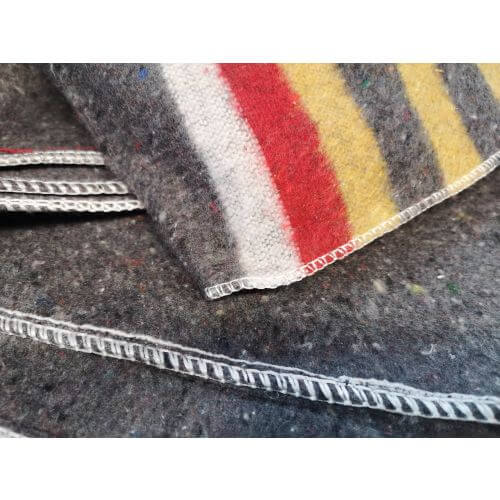
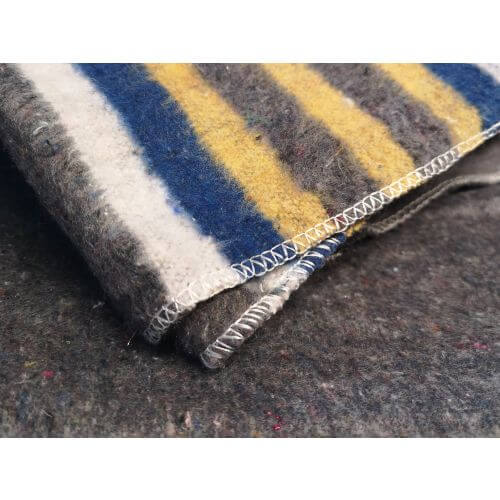
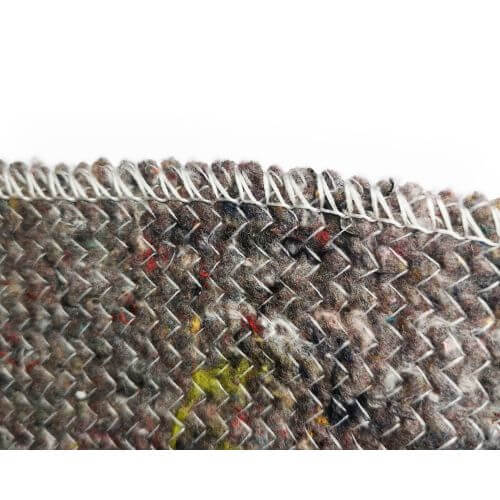
The woven blanket is the workhorse: a closed, sturdy structure that survives repeated sliding, folding and tensioning. That is precisely why it also handles washing best. The weave holds its shape because the fibres are locked in two directions, and the finished hems all round stop the blanket from fraying in the drum. You can wash this blanket season after season without trouble, which is why professional movers and hauliers almost always choose it.

per 1 Pieces  Densely woven, with wool Hemmed: will not fray 100% recycled textile

per 1 Pieces Green/white ID stripes Spot your own blankets Order per single piece 
per 1 Pieces Single blanket, 1300 grams Tops up your existing set Replace a worn blanket

Stitched storage blankets
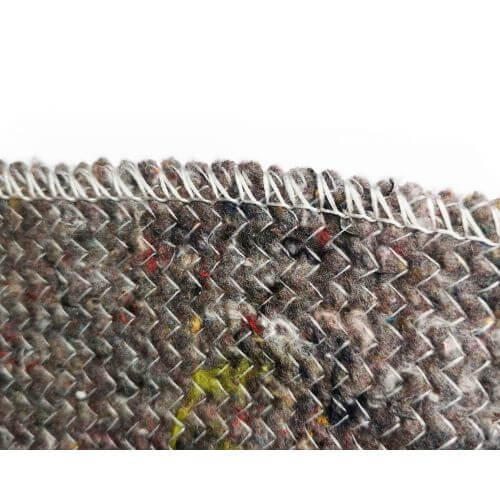
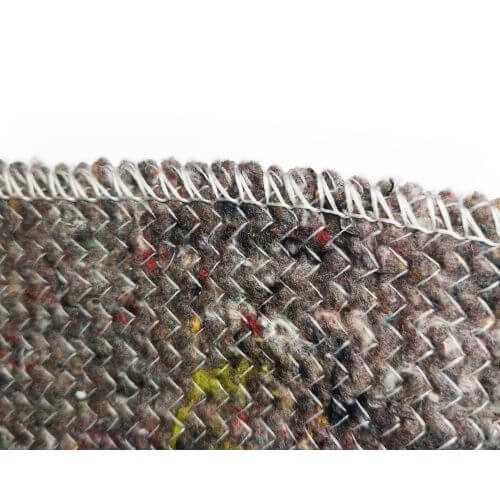
In a stitched blanket the fibres are compressed and held in place by lines of stitching rather than woven together. That makes the blanket softer and cheaper, but also more vulnerable in the drum: once the stitching gives way, the fibre filling shifts and thin patches appear that no longer protect anything. Wash these blankets on a delicate or wool cycle with a low spin speed. For a blanket that lies untouched over a cabinet in storage for months, that is more than enough.

per 1 Pieces Order a single blanket Check the quality first In stock
per 1 Pieces Five metres in one length For long worktops and doors 2500 grams, breathable
per 1 Pieces Three metres in one span Covers a whole wardrobe 1550 grams, breathable  Stock roll of 30 metres Cut to your own length Breathable, no condensation

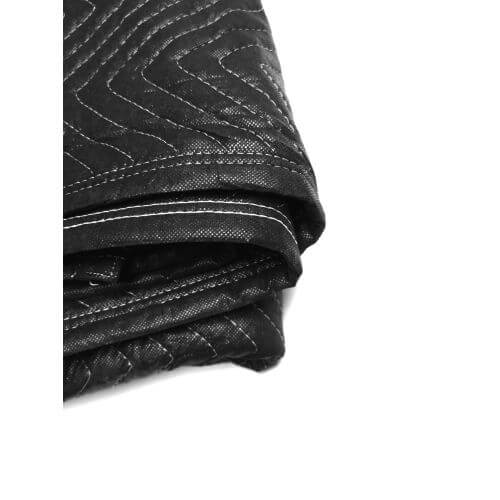
Padded blankets of 183 x 203 cm: keep them out of the machine
The padded blanket has a thicker filling between two layers of fabric and a larger surface area, so you can wrap a cabinet or sofa in a single movement. That very construction is what makes it unsuitable for the washing machine. Wash it anyway and the blanket is finished.

per 1 Pieces 2000 grams of padding Thickest layer on corners No lint, no colour rub-off 
per 1 Pieces Blends in outdoors Hides dirt and marks 2000 grams of cushioning 
per 1 Pieces 2750 grams: the heaviest Presentable at client sites Extra strong zigzag seam


Why can a padded blanket not be washed?
Three things go wrong at once. The filling is not quilted across the entire surface, so as soon as it gets wet and heavy it slumps to the bottom edge and clumps together there, leaving limp, empty areas behind. On top of that, the outer layer shrinks faster than the filling while drying, so the blanket starts to dome and no longer drapes flat over a piece of furniture. And third: a thick filling does not dry through completely for days, and a blanket stored while still damp will smell musty within a week. So treat stains on a padded blanket locally, with a damp cloth and a little mild detergent, and let only that spot dry.
How to wash a moving blanket without damaging it
Shake it out first
A moving blanket coming out of the van is full of sand, grit and splinters of wood. Let that go into the drum and it grinds through the weave with every rotation, and wears down your washing machine as well. Shake the blanket out outdoors, brush it in the direction of the weave and vacuum along the hems. This step takes two minutes and does more for the life of the blanket than the wash itself.
Wash one blanket at a time
This is the mistake made most often. A dry blanket already weighs well over a kilo, and wet that rises to three or four kilos. Two or three blankets together push a domestic machine far past its maximum load: the drum no longer reaches spin speed, the load does not rinse through and the bearings eventually give out. One blanket per cycle – and on a small machine (5 kg or less) even that is generous.
Why no fabric softener?
Fabric softener works by leaving a thin film of cationic surfactants on the fibres. It feels soft, but it is essentially a smooth coating. On a towel you notice it as reduced absorbency; on a moving blanket you notice it because the blanket slides off your furniture. The grip of a moving blanket comes entirely from its rough fibre structure – that is why a blanket stays put on a cabinet door without any tape. Take that structure away and you are left with a smooth sheet that slips down during the drive and leaves the furniture unprotected. For the same reason, avoid detergent pods that contain softener.
No bleach
Bleach breaks down the fibre itself, and in a blanket made of recycled fibres it does so unevenly because the fibres come from different sources. The result is a blanket with blotchy, weakened areas that tears at the first heavier cabinet. On coloured striped blankets you also lose the colour coding you use to tell them apart in the van.
Stubborn odours: vinegar instead of softener
If a blanket smells musty after a spell in storage, add about half a cup of household vinegar to the rinse compartment. Vinegar neutralises the odour compounds left behind by mould and bacteria and, unlike softener, leaves no film on the fibres. The vinegar smell itself disappears as the blanket dries. If the musty smell keeps coming back, the blanket was probably stored damp and the mould is in the fibre – at that point replacing it is cheaper than washing it again.
Can moving blankets go to a launderette?
Yes, and for anyone wanting to wash a full set at once it is the sensible route. The industrial machines in a launderette have a far larger drum volume, so the blankets keep enough room to rinse through properly. Do ask specifically for a cycle of 30 °C maximum without softener, because that is rarely the default setting. Skip the dryer there too.
Drying moving blankets: the dryer stays shut
What happens in a tumble dryer?
Inside a tumble dryer the blanket meets air of 50 to 70 °C, well beyond what the material tolerates. The cotton and wool fibres shrink back sharply while the synthetic fibres do not, and that difference locks into the weave: the blanket becomes harder, smaller and wavy. With stitched blankets there is the added problem that the tumbling makes the filling clump. A blanket that has been through the dryer once is usually no longer usable on large furniture.
How do you dry a 150 x 200 cm blanket?
Hang the blanket so air can reach both sides: across two lines of a rotary dryer, over a balcony railing, or over a door with a towel underneath. Over a single line it takes twice as long, because the blanket lies against itself. Outdoors in the wind a blanket is dry in a day; indoors, expect two to three days. Turn it halfway through so the fold line dries through as well.
Why must the blanket be bone dry before you store it?
A moving blanket holds moisture in its core for a long time, and you will not feel it on the outside. Fold it up in that state and stack it in a moving box or under a tarpaulin, and you create a closed, humid space in which mould and mildew take hold within days. That smell never fully washes out again, and the mould attacks the fibre over time. So always feel inside the fold and along the hem before you put the blankets away.
Keeping blankets clean without washing
Most blankets never need washing at all. Removal firms wash theirs a few times a year at most and keep them clean the rest of the time in the ways below – it is faster and it spares the weave.
Shaking, brushing and vacuuming
Dry dirt – sand, grit, wood chips, plaster – accounts for the vast majority of what makes a blanket dirty, and it comes off mechanically. Shake the blanket out, brush it in one direction with a stiff brush and vacuum the hems and stitching, because that is where the grit collects. Do this after every job and the blanket only needs washing when something has actually been spilled on it.
Treating stains locally
A full wash for one stain is a waste. Dab the spot with a damp cloth and a drop of mild detergent, work from the outside inwards so the stain does not spread, and let only that section dry. On fresh stains this works almost every time; dried-in stains need soaking with lukewarm water first.
Paint, oil and glue
These three will not come out, not even at 30 °C. Paint and glue bond into the fibre and oil leaves a permanent dark ring. That is no disaster: a blanket with paint marks still performs perfectly as covering material during renovation and painting work, or as a layer beneath lashing straps in machine transport. Keep your stained blankets separate from the ones you use on furniture, and for painting work reach for protective film or a tarpaulin instead.
When should you replace a moving blanket?
How do you tell a blanket is finished?
Do not judge it by how clean it is, but by how much mass it still has. A blanket protects because it is heavy and thick enough to absorb an impact; a thin, worn-through blanket is little more than a dust sheet. Replace the blanket as soon as you can see light through it when you hold it up to a window, as soon as the hems have frayed open over more than a hand's width, or as soon as whole areas of a stitched blanket have lost their filling. A torn blanket still works well as covering material, but not for wrapping a cabinet.
How often can you wash a blanket?
There is no fixed number of wash cycles, but every wash costs a little fibre strength. In normal professional use, a woven blanket lasts for years if you wash it a few times a year and keep it clean by dry methods the rest of the time. Wash it every month and you will see it thin out noticeably faster. The rule of thumb: wash when something has been spilled or the blanket smells musty, and shake it out the rest of the time.
Which blanket suits which job?
Moving and transport
For work where the blanket goes around furniture again and again, gets pulled tight and folded back up, choose the woven version. The 150 x 200 cm blanket with red stripes is a common working size. Combine it with elastics from the moving accessories so the blanket does not shift while carrying.
Long-term storage
If an item stands untouched in a warehouse or storage unit for months, a stitched storage blanket is enough: nothing pulls at it, and the blanket mainly has to keep out dust and light. Why a storage blanket is sufficient here and a moving blanket is not needed is set out in more detail in our article on storage blankets versus moving blankets. More important than the choice of blanket is that the item goes into storage bone dry. For fragile or long-stored pieces, furniture covers close off better because they seal all round.
Renovation, painting and machine transport
For these jobs the blanket does not need to be clean, which is exactly where your retired blankets still earn their keep. Beneath lashing straps a blanket stops the strap cutting into paintwork; on the floor it catches dropped tools. Working indoors, put a proper floor protector under the blanket as well, because a blanket alone will not stop spilled paint. The full range is under moving blankets.
In short
- Woven moving blankets and stitched storage blankets go in the machine at 30 °C maximum.
- Padded blankets of 183 x 203 cm do not go in the washing machine: spot-clean them.
- Never fabric softener, pods or bleach – they strip the blanket of grip and strength.
- Never a tumble dryer; air-dry until the blanket is bone dry right into the fold.
- One blanket per cycle, or take the whole set to a launderette.
- Shake the blanket out after every job; that saves most of the washing.
- Replace the blanket once you can see light through it or the hems let go.
Ordered on working days before 3:30 PM? Then your order will be shipped the same day. Enjoy free delivery on orders over €75 excl. VAT.
Do you have questions about which size of moving blankets is best suited to your situation? Please don't hesitate to contact us — by phone on +31 184 – 614256, via info@kortpack.nl or via WhatsApp.
 Den Webshop auf Deutsch ansehen
 View the webshop in English
 Ver la tienda online en Español
 Voir la boutique en ligne en Français
 Visualizza il negozio online in Italiano
 Bekijk de webshop in het Nederlands