

 Free gifts with orders of €150 or more



 Loading...
The short answer: cable tie
Cable tie is the correct term in technical and professional English. It is the wording you will find in standards, datasheets and tender documents, and it is unambiguous everywhere in the English-speaking world. Zip tie is the common American equivalent – perfectly clear in conversation, but less usual in formal documentation. Tie wrap and tyrap both trace back to a brand name rather than to the English language itself.
So why does this shop sometimes say "tyrap"?
Because our roots are Dutch, and a large part of our customer base searches for exactly that word. Whichever term you type, you land in the same place: our cable ties category.
Where does the name Ty-Rap® come from?
An invention from 1958
The cable tie was developed by engineer Maurus Logan at the American company Thomas & Betts. Visiting an aircraft plant in 1956, Logan watched fitters tie down kilometres of wiring by hand using waxed cord – slow, laborious and hard on the fingers. His answer was filed for patent in June 1958: a plastic strap with a toothed rack and a locking head that grips itself and cannot run back. The Ty-Rap® trademark now belongs to ABB, and you will find the originals in our Thomas & Betts cable ties range.

per 1.000 Pieces
 bundle diameter 16mm tensile strength 8kg Polyamide 6.6

per 1.000 Pieces
Bundle diameter 45mm Tensile strength 23kg Polyamide 6.6 
per 1.000 Pieces
Tensile strength 22.78 Polyamide 6.6 Stainless steel 316 locking mechanism 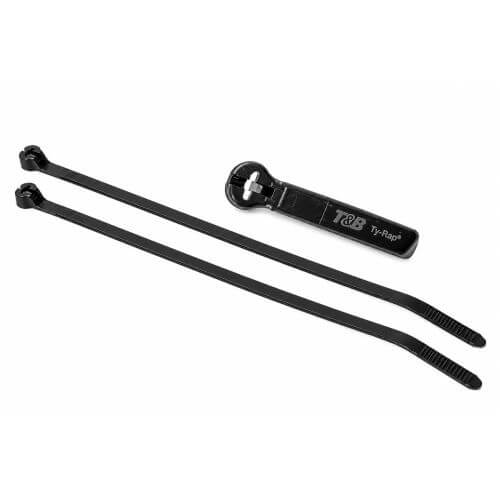
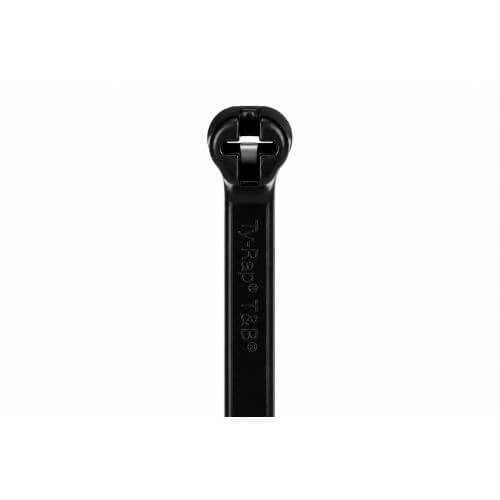
per 1.000 Pieces
Bundle diameter 102mm Tensile strength 23 kg Polypropylene From brand name to generic term
What happened next is the story of Hoover, Biro and Sellotape all over again: the brand name became the product name – but a different brand won in each country. In the Netherlands and Belgium it was Ty-Rap, shortened to tyrap. In France it was Rilsan and Colson. English-speaking countries kept the plainly descriptive cable tie, with zip tie emerging in the United States from the zipper-like ratcheting sound.
Every name at a glance
| Term | Correct in professional English? | Origin and use |
|---|---|---|
| cable tie | Yes | The standard technical term; safe for specifications and tenders. |
| zip tie | Yes, informally | Common in the United States; named after the sound of the ratchet. |
| tie wrap | No | Derived from the brand name; widely used in continental Europe. |
| Ty-Rap® | Brand name | Correct only for the original Thomas & Betts / ABB product. |
| tyrap / tie-wrap | No | Dutch generic spellings of the brand name. |
| wire tie / bundling strap | Acceptable | Understandable but less precise; may also mean a twist tie. |
| hose tie / tie strap | No | Occasional workshop slang; avoid in written documentation. |
Which term belongs in a specification or tender?
Use cable tie, followed by the properties that actually matter: material, width, length and minimum tensile strength. A brand name such as Ty-Rap® in a specification reads as a product mandate, which can cause problems in public procurement. For marketing copy or an internal order list, any of the common terms will do.
Can you call every cable tie a Ty-Rap®?
Strictly speaking, no. Ty-Rap® is a registered trademark covering the original product only. For the product group as a whole, write cable tie. Nobody will object on the shop floor, but in printed documentation it is worth keeping the distinction.
What is a cable tie called elsewhere in Europe?
| Language | Standard term | Alternative |
|---|---|---|
| English | cable tie | zip tie (US), tie wrap |
| Dutch | kabelbinder | tiewrap, tyrap |
| German | Kabelbinder | Kabelband |
| French | collier de serrage | serre-câble, collier Rilsan |
| Spanish | brida de cable | abrazadera, cincho (Latin America) |
| Italian | fascetta stringicavo | fascetta per cavi |
What actually matters when you order
The name makes no difference to how the tie performs; the specifications do. The table below shows the range we carry.
| Property | Range | What it means |
|---|---|---|
| Tensile strength | approx. 8 kg to 230 kg | The load at which the strap fails. Common classes: 8.1 – 18.2 – 22.2 – 54.4 – 79.4 – 114 kg. |
| Width | 2.5 mm to 13 mm | Together with thickness, determines strength and how firmly you can pull. |
| Length | from a few centimetres to 3,000 mm | Choose on the circumference of the bundle, not its diameter. |
| Standard material | polyamide 6.6 (nylon) | Tough and resilient; usable in practice between roughly -40 °C and +85 °C. |
| Colour | black, white and various colours | Black cable ties contain an additive that makes them UV resistant. |
Why does a white cable tie snap outdoors when a black one does not?
Because black cable ties contain an additive that makes them UV resistant, and white and coloured versions do not. Unprotected polyamide becomes brittle under prolonged sunlight: the strap loses its resilience and breaks under the next load it takes, often after a single season. Use white cable ties and cable ties in various colours indoors, and black or extra UV resistant cable ties outdoors. That single detail prevents most of the complaints we hear about broken ties.


per 100 Pieces
Free shipping from €75 Ordered before 3:30 PM, shipped today Free gifts when you spend €150 

per 100 Pieces
Tensile strength:22.2KG UV-resistant Reusable 

per 100 Pieces
Packed per 100 pieces 102?mm diameter 54.4?kg strength 

per 1.000 Pieces
Free shipping from €75 Both business and private Durable and reliable Which version suits which job?
| Situation | What you need |
|---|---|
| Indoors, bundling inside a cabinet | White cable ties or flat head cable ties for a flush finish |
| Outdoors, permanent | Black cable ties or extra UV resistant cable ties |
| Heavy bundles, site fencing, scaffold netting | Heavy duty cable ties |
| Temporary bundling, released later | Resealable cable ties or Velcro® fasteners |
| Frost, cold store, freezer warehouse | Cold resistant cable ties |
| Engine bay, high temperatures | Heat resistant cable ties |
| Chemical plant, offshore, salt air | Stainless steel cable ties or the stainless steel ladder variant |
| Food industry | Detectable cable ties, picked up by metal detection |
| Identifying cables and pipework | Cable ties with marker label or printed cable ties |
| Fixing to a wall or panel | Cable ties with attachment eye or cable ties with expansion anchor |
| Extra strong locking head | Metal tooth cable ties or ladder ties |
| Securing tags and price tickets | Secure attachments or injection moulded ties |
| A more sustainable option | Recycled cable ties or FibreStrap paper cable ties |
Do you need a tool?
Not for occasional use. If you fit dozens a day, yes: a pair of cable tie pliers lets you set the tension and cuts the tail off flush. That saves time, but it also removes the sharp stubs fitters cut themselves on and prevents the over-tightening that makes a tie fail later. If you want no tail at all, look at the cable tie Twist & Cut, where you simply twist the end off.
Can a cable tie be reused?
A standard one cannot: the locking head bites irreversibly into the rack, and releasing it means cutting it off. If you need regular access to the bundle, choose resealable cable ties with a release tab, Velcro® One-Wrap® straps or spiral wrapping band. The last two survive hundreds of cycles, which makes them cheaper over time than disposable ties.
What other options are there?
Alongside cable ties we stock loop wires for closing sacks quickly, heat shrink tubing for insulating and finishing cable ends, and Velcro® on a roll for bundles you want to cut to length yourself. The full overview sits under closure materials.
In summary
- Cable tie is the correct professional term; zip tie is fine informally, especially in the United States.
- Ty-Rap® is a Thomas & Betts trademark, patented in 1958 for aircraft wiring.
- Tyrap and tie wrap are continental European generics derived from that brand.
- Searching abroad? Try Kabelbinder, collier de serrage, brida or fascetta.
- Outdoors, always choose black or UV resistant – there, colour is a technical decision, not a cosmetic one.
Ordering cable ties from Kortpack
Whatever you call them, you will find the full range under cable ties: from slim bundling straps to heavy duty versions and stainless steel. Ordered on working days before 3:30 PM? Then your order will be shipped the same day. Enjoy free delivery on orders over €75 excl. VAT.
Do you have questions about which size of cable ties is best suited to your situation? Please don't hesitate to contact us — by phone on +31 184 – 614256, via info@kortpack.nl or via WhatsApp.
 Den Webshop auf Deutsch ansehen
 View the webshop in English
 Ver la tienda online en Español
 Voir la boutique en ligne en Français
 Visualizza il negozio online in Italiano
 Bekijk de webshop in het Nederlands